If you're looking for the quick and dirty answer, here it is: the best times to post on LinkedIn are generally between 10 AM and noon on Tuesdays, Wednesdays, and Thursdays. This is the sweet spot—that midweek, mid-morning window when most professionals have settled into their workday, cleared out their inboxes, and are ready to scroll.
Why Posting Time Is Your Secret Weapon on LinkedIn
Ever poured your heart and soul into a LinkedIn post, only to see it get a handful of views and quietly fade away? It’s a frustrating feeling. The secret to avoiding this isn't just about what you post, but when you post it.
Think of it like trying to get a primetime TV slot for an ad. You wouldn't run your best commercial at 3 AM, right? You want it live when the most people are watching. The LinkedIn feed works in a similar way. The algorithm is designed to push fresh, relevant content to an active audience, which can create a powerful snowball effect for your visibility.
The All-Important "Golden Hour"
The first 60 minutes after you hit "publish" are absolutely critical. This is your content's "golden hour." Early likes, comments, and shares within this window send a massive signal to the LinkedIn algorithm that people find your post interesting.
When the algorithm sees that initial burst of engagement, it rewards you by pushing the post out to a wider network. A post that catches fire in its first hour is far more likely to keep showing up in people's feeds for days to come.
Turning Guesswork Into a Real Strategy
Posting whenever the mood strikes is like throwing darts in the dark. You might get lucky and hit the bullseye, but most of the time, you'll miss. Your perfect message, shared when your audience is offline or in a meeting, simply won't land.
By understanding the daily and weekly rhythms of your specific audience, you can stop guessing and start being strategic. The whole point is to line up your content with the moments your audience is most likely to be scrolling, thinking, and ready to engage. This one simple shift can be the difference between a post that gets a few polite likes and one that sparks real conversations and builds your authority.
The "Golden Hours" for LinkedIn: A Data-Backed Starting Point
While there’s no single magic bullet for every audience, mountains of data have revealed clear patterns in when people are most active on LinkedIn. Think of it like a busy downtown street; you want to open your shop when foot traffic is at its absolute peak. These "golden hours" are your best shot at getting immediate eyeballs on your content.
On LinkedIn, that downtown street is busiest during the typical workday. Professionals are logging in to network, catch up on industry news, and share ideas. The logic is straightforward: you're meeting your audience where they already are, precisely when they're in a business frame of mind.
Why Midweek Reigns Supreme
Countless studies point to the same conclusion: the middle of the week is king. Mondays are usually a frantic scramble of catching up on emails and planning for the week ahead. By Friday, people are often winding down, with one foot already out the door for the weekend. That leaves a powerful sweet spot right in the middle.
Specifically, Tuesdays, Wednesdays, and Thursdays consistently come out on top. These are the days when professionals are deep into their work rhythm and actively seeking valuable content on the platform.
The chart below shows how different posting windows play a role in your post's overall reach and impact.
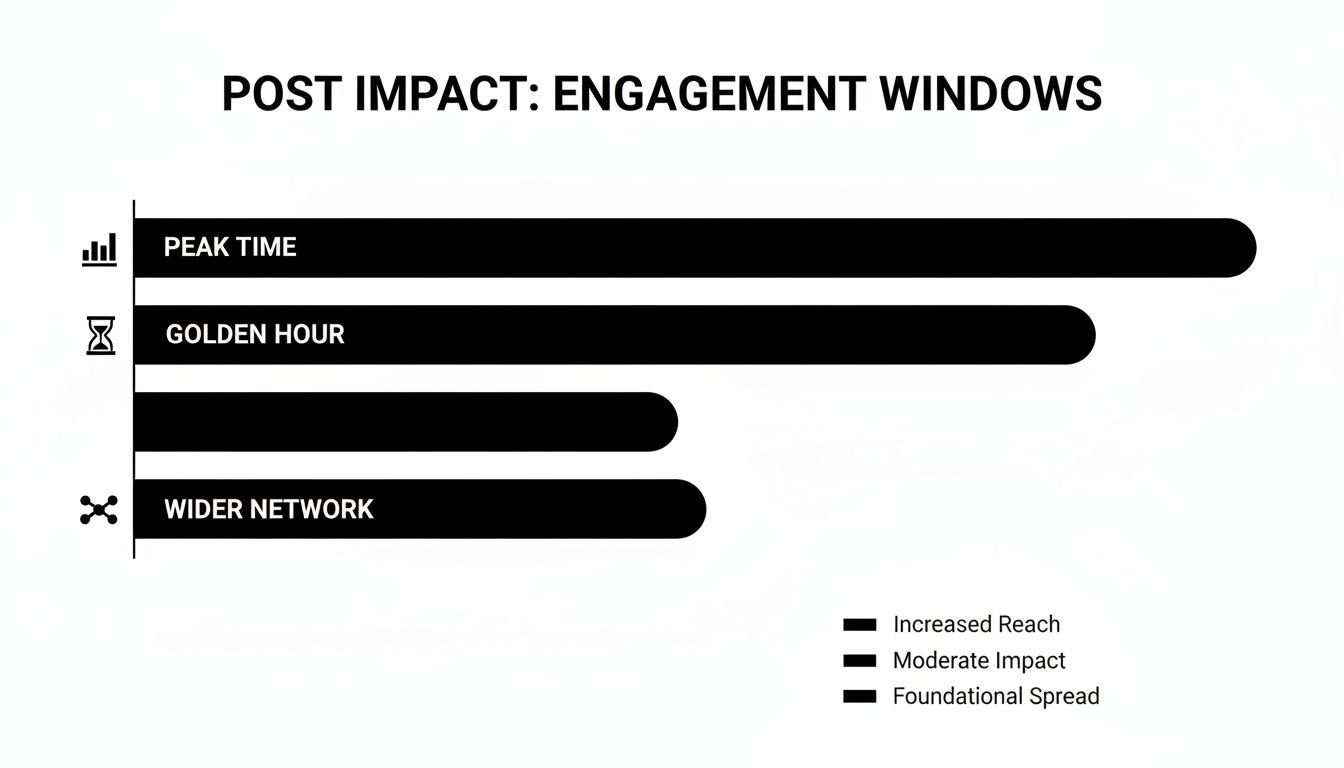
As you can see, narrowing your focus to that "Golden Hour" is what really gives your post the initial fuel it needs to take off.
Nailing the Exact Time
Within those peak days, we can get even more specific. The consensus for maximum engagement is midweek—Tuesday through Thursday—between 10 a.m. and 12 p.m. in your target audience's local time.
This window is pure gold. People have wrapped up their morning meetings but haven't left for lunch yet, making it the perfect time for a quick scroll. Research shows that posting during this window can lead to up to 30% higher interaction rates. You can discover more insights about LinkedIn engagement on sprinklr.com to see the full data.
The key takeaway: Posting during these proven windows is all about getting strong initial engagement. That early traction signals to the LinkedIn algorithm that your content is valuable, which prompts it to push your post out to a much wider network.
Think of these guidelines as your launchpad. They represent the most common high-engagement periods and give you a solid, data-informed foundation to start with. From here, the goal is to fine-tune this approach by digging into the unique habits of your specific industry and audience—because sometimes, the best results come from breaking the rules. But by starting here, you’re making an educated first move, not just a shot in the dark.
How Your Industry and Audience Rewrite the Rules
Those midweek "golden hours" are a fantastic starting point, but they're not a universal law. Think of them as the main highways on a city map. To find the real hidden gems, you have to turn down the side streets where your specific audience actually lives and works.
Your industry, your target audience's role, and their location are the factors that completely change the game. What works for a B2B SaaS company trying to reach VPs of Sales won't do much for a nonprofit hoping to connect with high school teachers.
The trick is to stop thinking about a generic "professional" and start picturing a day in the life of your ideal follower. When do they open LinkedIn?
Different Industries Operate on Different Clocks
A one-size-fits-all schedule just doesn't work because every industry marches to the beat of its own drum. The best time to post on LinkedIn is deeply tied to your audience’s daily routine.
Let’s look at a few examples:
- Healthcare Professionals: Doctors and nurses often have incredibly early starts. A post scheduled for 6:30 a.m. could catch them during a quick pre-shift coffee break, hours before someone in a corporate role has even hit the snooze button.
- Tech and Software Developers: This crowd is famous for its flexible, and sometimes unconventional, hours. You might find a surprising amount of engagement with an 8 p.m. post that catches them during a late-night coding session when inspiration hits.
- Creative Industries: People in marketing, design, and media often don't have rigid 9-to-5 schedules. Their peak activity might actually be during a mid-afternoon creative break, not the typical lunchtime scroll.
Your content succeeds when it meets your audience where they are. Don't try to force them into a generic schedule. Instead, adapt your timing to fit seamlessly into their actual workday. This one shift in perspective is what separates good content from content that truly connects.
Targeting Specific Roles and Time Zones
The same logic applies to job titles and geography. If you're a consultant trying to reach C-suite executives, posting during core business hours makes sense—that's when they are most likely at their desks making decisions.
But what if you're in global sales? You have to juggle multiple time zones. A single post won't effectively reach your prospects in both London and Los Angeles.
If your audience is spread across the globe, you can't just post at 10 a.m. your time and call it a day. You have to figure out where your most important audience segments are and schedule content that aligns with their peak hours. This is the point where you have to move beyond generalized advice and start testing what works for your unique following. You have to become a student of their behavior.
A Simple Blueprint for Finding Your Perfect Posting Time
Moving from general guidelines to a personalized strategy is where you'll find your real competitive edge. The industry-wide data gives you a fantastic starting point, but now it's time to put on your detective hat and uncover the unique habits of your specific audience. Let's run a simple experiment to find your own best time to post on LinkedIn.
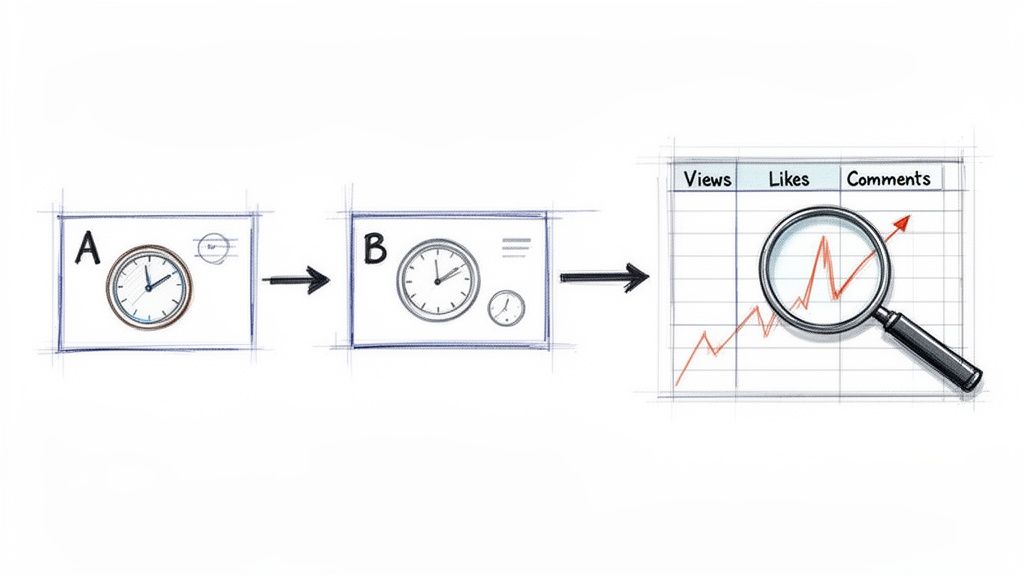
Think of it as A/B testing, but without any complicated software. The whole idea is to see how similar content performs when you post it at different times. By systematically testing various windows, you’ll be making decisions based on your own hard data, not just industry guesswork.
Setting Up Your Experiment
First things first: we need a consistent baseline. This whole experiment hinges on keeping the type of content you post as similar as possible. Comparing a text-only post on Tuesday morning to a video post on Wednesday afternoon will muddy your results, because the format itself has a huge impact on performance.
Here’s the game plan:
- Create Two Similar Posts: Draft two pieces of content that are very close in topic and format. For example, two text-based posts that each share a different tip on the same subject. To make sure your content has enough punch to get noticed, you could even use a LinkedIn headline generator for crafting compelling hooks.
- Pick Your Test Windows: Choose two different time slots. You could pit a proven industry time (like Wednesday at 10 AM) against one of your own hunches (maybe Thursday at 4 PM).
- Schedule and Post: Publish Post A in the first time slot this week. Then, next week, publish Post B in the second time slot.
This approach isolates time as the main thing you're testing, which gives you much cleaner insights into when your audience is actually paying attention.
Tracking Your Results for Clear Insights
To figure out what's working, you need to track the right numbers. Don't just glance at the view count and call it a day. Dig a little deeper to understand the quality of engagement each post is getting. Honestly, a basic spreadsheet is all you need to get started.
The most valuable insight isn't just knowing when people see your content, but when they're most willing to interact with it. A post with fewer views but more meaningful comments can be way more valuable than one with massive reach but zero conversation.
Create a simple tracker with these columns:
- Post Topic: A quick note on what the post was about.
- Day & Time: The exact day and time you hit "post."
- Views (24h): The number of impressions the post got in its first day.
- Likes (24h): Total likes within the first 24 hours.
- Comments (24h): Total comments in that same initial timeframe.
After a few weeks of this, you’ll start to see patterns emerge. You might find that your audience of software developers is surprisingly active at 9 PM on a Tuesday, or that the C-suite folks you're trying to reach always seem to engage during their lunch break. This personalized data is the secret to building a truly effective posting schedule.
Using Smart Tools to Automate and Optimize Your Schedule
Let's be honest, manually A/B testing your post times on LinkedIn works, but it’s a grind. It's time-consuming work that can pull you away from what really matters: creating great content and building relationships. This is where smart scheduling and analytics tools come into play. Think of them as your personal data scientist, working 24/7 to find your content’s sweet spot.
Instead of guessing based on broad industry averages, these platforms dig into your own account performance. They pinpoint the exact moments your network is scrolling, liking, and commenting. It’s like switching from a generic paper map to a live GPS that navigates you around traffic in real-time.
How AI-Powered Scheduling Works
Tools like LinkPilot are designed to take the guesswork completely out of the equation. They don't just let you schedule posts for later; they use AI to figure out the perfect time to drop each piece of content for maximum impact.
Here’s how they give you an edge:
- Data-Driven Recommendations: The system sifts through your past posts, identifying engagement patterns and peak times that would be nearly impossible to spot on your own.
- Serious Time Savings: You can stop logging in at odd hours just to hit a specific posting window. Batch your content creation, load up your calendar for weeks, and let the tool handle the rest.
- Constant Improvement: The more you use it, the smarter it gets. The platform continuously learns from your new posts, refining its recommendations so your timing gets better and better.
Visualize and Refine with Analytics
One of the biggest wins of using a dedicated tool is getting a visual calendar and a powerful analytics dashboard all in one place. This gives you a clear command center to see what’s planned and how it’s performing.
A good scheduling calendar provides a bird's-eye view of your content pipeline. You can instantly see if you’re posting consistently or if there are awkward gaps in your schedule.
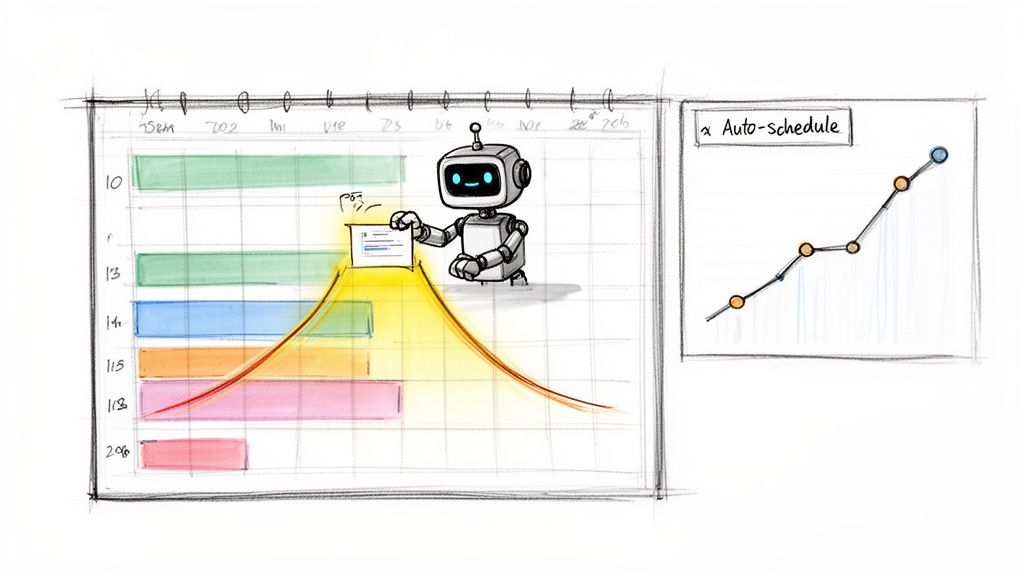
When you combine that kind of visual planning with deep performance analytics, you create a powerful feedback loop. You're no longer just throwing content out there; you're making strategic, informed decisions that lead to better results over time.
The real goal of automation isn't just to save a few minutes. It's to make smarter, data-backed decisions that amplify your voice. These tools handle the number-crunching so you can focus on creating content that truly connects.
By putting the right systems in place, you graduate from simply finding the "best time to post" to building a reliable engine for growth on LinkedIn. You can check out various automation tools for LinkedIn growth that help with everything from scheduling to outreach, making your entire strategy more effective. This is how you ensure your hard work consistently gets in front of the right people at the right time.
Beyond Timing: The Other Pillars of LinkedIn Success
Nailing the perfect time to post on LinkedIn gives your content a fantastic head start, but let's be honest—perfect timing can't rescue a bad post.
Think of it like a stand-up comedian. They can get the best primetime slot at the best club in the city, but if the jokes don't land, the room will be silent. Timing gets you on stage; great content is what earns you the applause. It's just one piece of a much bigger puzzle.
To really see consistent growth, you have to think about the whole picture. When you finally hit "publish" during that golden window you found, your content needs to be ready to shine.
The Content and Engagement Flywheel
Success on LinkedIn isn't just about showing up when people are online; it's about showing up with something worth their time. This is where your content quality and your own engagement habits come into play.
-
Create genuinely valuable content: Your posts should solve a real problem, offer a fresh perspective, or teach your audience something they didn't know. Content that educates and inspires is what stops the endless scroll.
-
Write irresistible hooks: You have one or two lines to grab someone's attention. That’s it. A strong, curiosity-piquing hook isn't just nice to have—it's absolutely essential in a busy feed.
-
Use engaging formats: Don't just stick to text. Data consistently shows that formats like carousels and polls get far more interaction. Mix it up with videos and multi-image posts to keep things visually interesting. Our guide on making a LinkedIn carousel post is a great place to start with this high-impact format.
-
Interact with your network: Never just post and ghost. The real magic happens in the conversations. Respond to every comment on your posts and take the time to engage thoughtfully with what others are sharing. This tells the algorithm you're an active member of the community, not just a broadcaster.
A great post at the wrong time might go unnoticed, but a weak post at the right time is a wasted opportunity. The goal is to align exceptional content with optimal timing for maximum impact.
Common Questions About LinkedIn Posting Times, Answered
Alright, you've got the general strategy down, but a few nagging questions always seem to pop up when you're about to hit "publish." Let's clear those up right now so you can move forward with confidence.
How Often Should I Be Posting on LinkedIn, Really?
This is a big one. The sweet spot for most people and brands is somewhere between two and five times per week.
Think of it this way: posting less than twice a week makes it tough to stay on anyone's radar. On the flip side, posting every single day can actually backfire if your content isn't pure gold—people just start tuning you out. Sticking to a 2-5 post per week schedule keeps you visible without burning out your audience (or yourself).
The golden rule here is quality over quantity. I'd much rather see you share three killer posts that spark real conversation than seven mediocre ones that just add to the noise.
Is Posting on the Weekend a Waste of Time?
For the most part, yes. Weekends on LinkedIn are usually a ghost town. Engagement drops off a cliff because most professionals have logged off for a well-deserved break. That's why Saturday and Sunday are consistently ranked as the worst days to post.
But there are always exceptions. If you're targeting an industry with a non-traditional schedule or you know for a fact your audience is active, then by all means, run a test. For everyone else, though, focusing your best content on the Tuesday-Thursday window is a much smarter bet.
What Do I Do If My Audience Is in Different Time Zones?
This is a great problem to have—it means your reach is growing! But posting at 10 AM in New York isn't going to do you any favors with your audience in London or Singapore.
Here’s how to handle it:
- Pinpoint your audience hubs: First, jump into your LinkedIn Analytics and see which countries or regions your followers are from. Don't just guess.
- Focus on the biggest groups: If you have a huge following in both North America and Europe, for example, it’s worth creating a schedule that caters to both. That might mean posting once in the morning for Europe and again later in the day for the US.
- Let a tool do the heavy lifting: Honestly, this is the easiest way. A scheduling tool can automatically push your content out at the right time for each of your key audience segments. You get maximum visibility without having to wake up at 3 AM to do it manually.
Stop guessing and start growing. LinkPilot uses AI to analyze your audience and automatically schedule your content for the perfect moment. Try LinkPilot for free and see the difference data makes.
Produced via the Outrank tool